
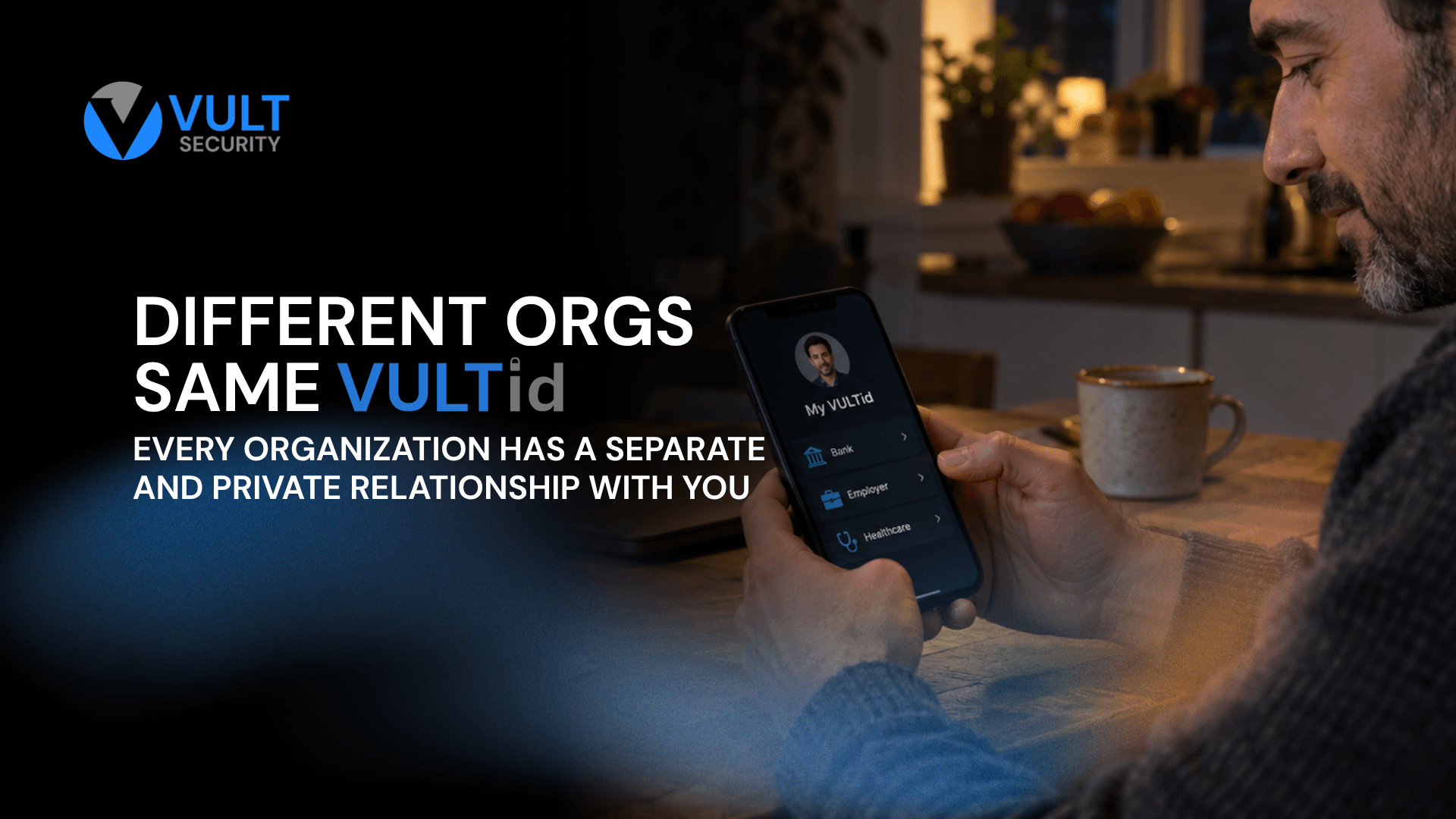
You do not become a different human every time you open a new account.
Your bank knows you as a customer. Your employer knows you as an employee. A hospital knows you as a patient. A government agency may know you as a citizen, beneficiary, license holder, or authorized official.
Each organization gives you a different account. Each account may carry different permissions. Each organization keeps its own records, applies its own policies, and decides what you are allowed to do within its environment.
But underneath all those relationships is the same human.
Today, every organization tries to establish that human independently. You upload the same identity documents again. You take another selfie. You create another credential. Another identity record is stored in another system.
VULT Security separates the human from the accounts built around them.
One human can establish one VULTid and use it with many organizations. Each organization still owns its account, permissions, policies, and data. The organizations do not need to share those things with one another, and using VULTid with a second organization does not create a second VULTid.
It creates a new, separate relationship with the same verified human.
One human. One VULTid. Many independent organizations.
What Happens When Someone Uses VULTid With Multiple Organizations?
VULTid is the person's reusable verified identity.
An organization does not issue the VULTid. It issues its own account and decides what that account is permitted to access, approve, or perform.
When the person uses VULTid with another organization, VULT Security does not create another human identity simply because the organization presents a different login screen or creates a different customer record.
The same VULTid establishes a separate organization-specific connection.
For example:
- Bank A creates a customer account with permission to view balances and move money
- Employer B creates a workforce account with permission to access payroll or internal systems
- Hospital C creates a patient account with permission to view records and approve care decisions
- Government Agency D creates a constituent account with access to specific services or benefits
The accounts are different.
The permissions are different.
The organizations are different.
The verified human is the same.
The Three Domains Must Remain Separate
VULT Security is designed around three distinct domains: the human domain, the VULT Security domain, and the organization domain.
Domain | What It Owns |
Human Domain | The real person, their verified identity, real-time presence, and explicit approval |
VULT Security Domain | Identity verification, biometric Proof-of-Presence, organization-specific identity binding, authenticated approval, and protected evidence |
Organization Domain | The account, permissions, policies, data, transactions, services, and authorization events |
Keeping these domains separate prevents any one participant from being confused with another.
The organization does not become the source of the person's identity.
VULT Security does not decide what the person is allowed to do inside the organization.
The person does not gain permission merely because their identity has been verified.
Each domain performs its own job.
The organization grants permission.
VULT Security proves which verified human is using that permission.
The human provides real-time presence and approval when the event requires it.
Permission belongs to the organization. Identity belongs to the human. VULT Security proves when the two meet.
One VULTid Does Not Mean One Universal Account
The phrase “one identity” can easily create the wrong picture.
VULTid is not a universal account that replaces every bank account, employee profile, patient portal, or government record.
It does not merge an individual's activities into one public profile.
It does not give one organization visibility into the person's relationship with another organization.
It does not cause Bank A to inherit permissions from Employer B or allow Hospital C to inspect activity inside Government Agency D.
VULTid establishes the human. The organization establishes the relationship.
That distinction is the foundation of the architecture.
A person can therefore use the same VULTid to access two organizations that happen to use similar login experiences without creating two separate VULTids. Each organization sees only its own account relationship and the verified information required for its own interaction.
The human remains consistent.
The organizational context remains isolated.
Cross-Network Does Not Mean Cross-Sharing
Cross-network identity is often misunderstood as a large shared database through which every participating organization can see the same person and all of their activity.
That is not what VULT Security means by cross-network.
Cross-network means a verified-human capability can work across more than one participating organization. It is a one-to-many relationship between one VULTid and multiple organization-specific accounts.
It does not mean that the organizations share their customer records, permissions, transaction histories, or internal data with one another.
Bank A does not need to know that the person also uses VULTid with Bank B.
An employer does not need to know which financial institutions use the same verified-human infrastructure.
A healthcare provider does not receive the person's unrelated government or employment activity.
The identity connection can be scoped to each organization so that the identifier and relationship used in one environment are not the same organizational record used in another.
This approach is consistent with established privacy-enhancing identity design. NIST defines a pairwise pseudonymous identifier as an identifier created for a specific relying party, helping prevent the identifier used by one organization from becoming a universal tracking key across other organizations. NIST Pairwise Pseudonymous Identifier
The OpenID Foundation likewise describes pairwise identifiers as a way to represent the same user differently to separate relying parties, reducing unwanted correlation across organizations. OpenID International Government Assurance Profile
The principle is simple:
Interoperability should travel. Organizational data should not.
Cross-Network Identity Must Not Become Cross-Network Exposure
There is an obvious danger in building identity infrastructure that works across many organizations.
If every participating organization receives the same identity record, biometric, or universal customer identifier, interoperability can quietly become surveillance. A network designed to make identity reusable can also make a person easier to track, correlate, and expose.
VULT Security is designed to avoid that outcome.
The same VULTid can work across multiple organizations without giving every organization possession of the person's underlying identity evidence or biometric information.
Each organization receives only what its own relationship requires. That may be a verified-human confirmation, a requested identity attribute, real-time Proof-of-Presence, or an authenticated approval bound to a specific event.
The organization does not receive the person's biometric template. It does not receive another organization's account information. It does not receive a map showing everywhere else the person uses VULTid.
Cross-network utility comes from the reuse of verified-human proof, not the unrestricted circulation of human data.
How VULT Security Protects the Human's Identity and Biometrics
Reusable identity becomes dangerous when reuse means repeatedly copying the same government ID, face image, and personal information into more databases.
VULT Security does not rely on that model.
During VULTid enrollment, VULT Security validates a government-issued identity document and biometrically matches the live person to its rightful owner using real-time liveness detection.
After verification is completed, VULT Security does not retain the government ID image or the raw facial image. Participating organizations do not receive or store the person's biometric data through the VULTid process.
VULT Security retains a protected, non-reversible facial template for future Proof-of-Presence comparisons.
A facial template is not a photograph. It is a mathematical representation designed for biometric comparison. Non-reversible means it is designed so the original face image cannot be reconstructed from the stored template.
VULT Security protects that template using homomorphic encryption with rotating encryption keys. Homomorphic encryption allows supported computations to be performed on encrypted information without first exposing the underlying data in readable form. NIST describes homomorphic encryption as a form of encryption that supports evaluation over encrypted data. NIST Fully Homomorphic Encryption
The protection model is layered:
- The government ID is used to establish the identity but is not retained as an ID image
- The live face is used to establish the rightful human but is not retained as a face image
- The organization does not receive the person's biometric data
- The retained facial template is non-reversible
- The template is protected through homomorphic encryption
- Encryption keys rotate rather than remaining permanently static
- Each organization receives only the verified result or information required for its own interaction
This sharply reduces the sensitive identity material available to steal from the VULTid workflow.
It also prevents organizations from accumulating new biometric honey pots merely because they want stronger identity assurance.
NIST's Digital Identity Guidelines support the underlying principle: collecting and retaining less personal information reduces the amount exposed to unauthorized access or use. NIST SP 800-63A Privacy Requirements
No responsible security provider should claim that all PII everywhere is impossible to breach. An organization may already hold names, addresses, financial records, medical information, or other data for its own legitimate purposes.
The stronger and more accurate VULT Security promise is this:
VULTid does not require an organization to possess the human's government ID image, face image, or biometric template in order to verify them.
If the organization never receives those identity artifacts, those artifacts cannot be stolen from that organization's VULTid integration.
The organization gets the proof. The human keeps the privacy.
How Can VULT Security Work Across Networks and Still Stay Local?
The same separation allows VULT Security to support two seemingly different deployment needs.
In a cross-network model, one VULTid can be accepted by multiple participating organizations. Each organization establishes its own account relationship and requests only the verified information or authorization proof required for its event.
In a contained enterprise environment, VULT Enterprise can operate within the organization's own account, policy, and data boundaries. The enterprise can use verified-human identity and Proof-of-Presence without sharing its internal records, permissions, or activity with other organizations.
VULT Sovereign can provide the same separation for government, defense, and other controlled or mission-specific environments where infrastructure, policies, or data must remain within a defined boundary.
The human layer can be reusable where reuse is permitted.
The organization layer remains local.
The architecture does not require every participant to surrender control of its systems in order to benefit from a common standard of verified-human proof.
VULT Security Does Not Grant Permissions
This boundary deserves special attention.
Verifying a human does not mean authorizing that human to do everything.
An organization may verify that a particular person is real and still give that person very limited access. Another person may hold broader privileges because of their job, account type, legal capacity, or assigned role.
VULT Security does not decide who may release a wire, alter payroll, approve medical treatment, access a protected system, or direct an AI agent.
The organization decides that.
VULT Security answers a different question:
Is the human using this account the verified person to whom these permissions were assigned?
And when a protected action occurs:
Is that authorized human present and personally approving this exact action?
This keeps identity verification, account authentication, organizational permission, and human authorization from being collapsed into one vague “auth” decision.
The National Institute of Standards and Technology uses a similar separation in its digital identity model. A relying party provides the service and relies on identity assertions when granting access, while identity proofing, authentication, and federation remain distinct functions. NIST Digital Identity Guidelines
VULT Security adds verified-human authorization at the moment the organization's existing permissions are used.
How Does VULTid Prevent Duplicate and Multiple Accounts?
Traditional duplicate-account controls usually compare information.
Does the name match?
Is the email already registered?
Has this phone number appeared before?
Does the address look familiar?
Those signals are useful, but they are not the human. Names can be entered differently. Email addresses are nearly unlimited. Phone numbers change. Addresses can be shared. Identity documents can be stolen or manipulated.
VULTid allows the organization to apply its account policy to the verified human rather than only to the information presented by the applicant.
If an organization permits only one account per person, VULT Security can identify that the same verified human is attempting to create or control another account within that organization's environment.
The individual cannot become a second human by using:
- Another email address
- Another phone number
- A different username
- A new device
- A variation of their name
- Another login method
The organization can recognize that the underlying verified human is the same.
This does not mean VULT Security must impose one account per human everywhere.
A bank may legitimately allow one person to have checking, savings, business, trust, and joint-account relationships. An employer may allow separate workforce and benefits profiles. A marketplace may permit personal and business accounts.
The organization sets the rule.
VULT Security gives the organization a dependable human-level control with which to enforce it.
The result can be:
- One verified-human per permitted account
- One permitted account per verified-human when required
- Multiple legitimate accounts tied to the same verified-human when policy allows
- Prevention of hidden duplicate accounts created to evade limits or enforcement
- Stronger detection of coordinated account abuse
Duplicate prevention becomes a policy decision backed by verified-human identity, not a guessing exercise based on matching data.
Why Organization-Scoped Identity Matters for Privacy
Stopping duplicate accounts creates an obvious privacy concern.
If the same human can be recognized across a network, does that create a universal tracking system?
It should not.
The goal is not to give every organization a common public number for every person. That would allow unrelated parties to correlate activity across environments and rebuild a centralized view of the individual.
The safer model is organization-scoped identity binding.
Within its own domain, an organization can consistently recognize the same verified human and enforce its own duplicate-account policy. Outside that domain, another organization receives its own relationship and only the information required for its purpose.
The same human sits behind both relationships, but the organizations do not need a shared customer identifier or shared behavioral record.
This allows VULT Security to deliver two outcomes that are often treated as opposites:
Human uniqueness within the organization. Privacy across organizations.
What Happens When a Person Leaves an Organization?
Because the domains remain separate, ending one organizational relationship does not erase the person or destroy their VULTid.
If an employee leaves a company, the company disables the employee account and removes its permissions.
The person's VULTid remains their verified identity.
If a customer closes a bank account, the bank ends that account relationship.
The person does not cease to be verified everywhere else.
If an organization changes a person's role, the organization changes the permissions attached to its account.
VULT Security does not rewrite the human's identity merely because one institution changed its relationship with them.
This is another benefit of separating identity from organizational permission.
Accounts can begin and end.
Permissions can expand and contract.
The human remains the human.
One Human Across the Authorization Economy
The long-term value of VULTid is not a universal username.
It is a universal ability for a human to prove themselves wherever verified identity, presence, or approval is required.
A person should not have to become a new digital human for every bank, hospital, employer, government agency, platform, or network they enter.
At the same time, no organization should have to surrender its account structure, permissions, data, or operational independence to participate.
VULT Security makes both possible.
One VULTid can serve many separate relationships.
Each organization remains its own domain.
Each account retains its own permissions.
Each protected action remains its own Authorization Event.
And when approval matters, VULT Security proves that the authorized human is present and personally approving that exact action.
One human. One VULTid. Many organizations. Every relationship separate.


