
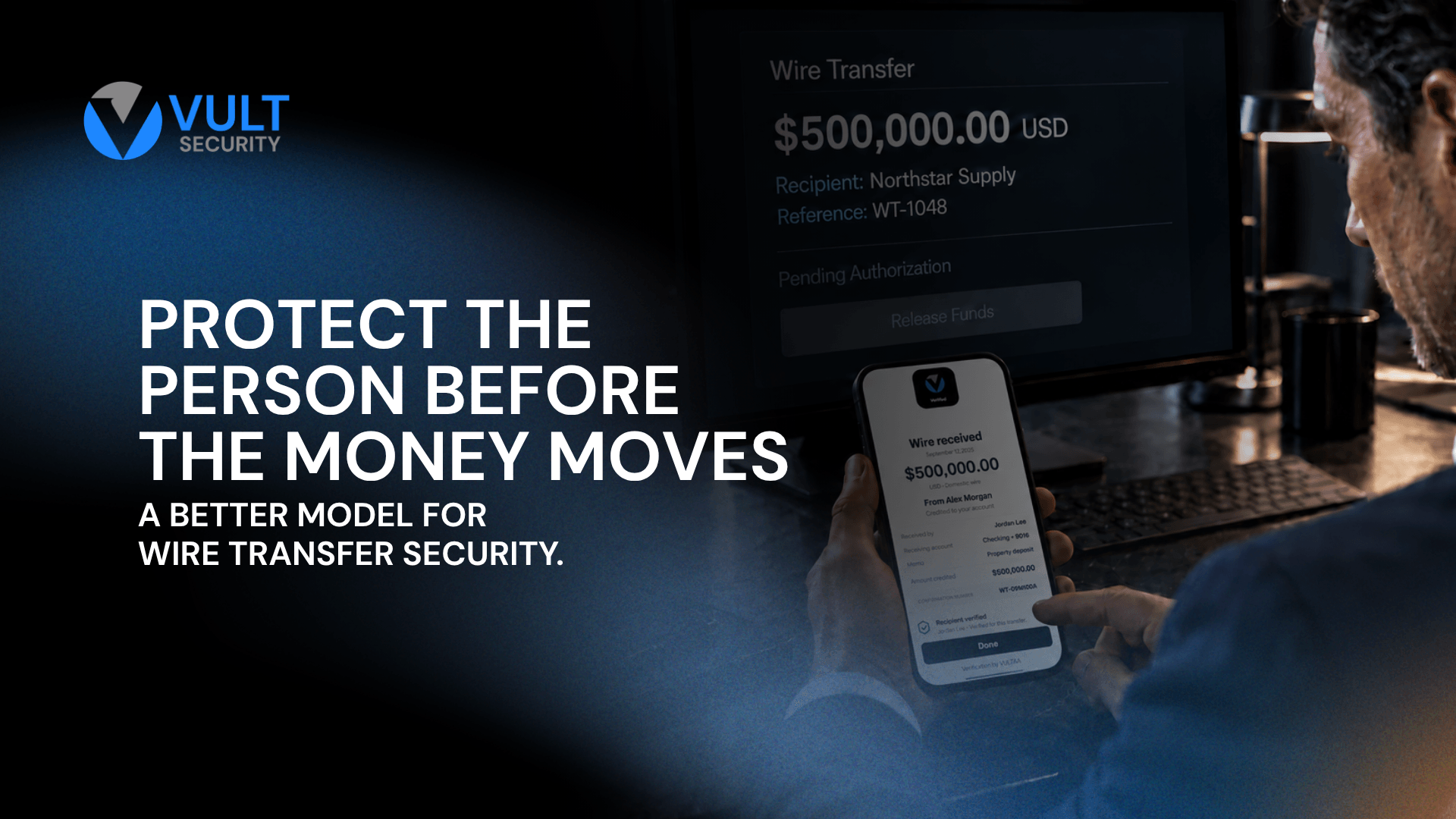
A $500,000 wire is ready to leave a business account. The login succeeded. The device is recognized. The user has permission to move the money. Everything the bank expects to see is there.
But has the person with that permission personally authorized this exact transfer?
That question matters because access to an account and authorization of a wire are separate events. A legitimate sign-in does not automatically establish who is directing the next transaction, what they were shown or whether the transfer still matches their instructions.
Verified-human wire authorization confirms that the person authorized by the bank is present and personally authorizing a specific transfer before funds are released. VULT Security connects a government-ID-verified identity, real-time human presence and the exact wire details in one protected authorization event.
The bank keeps control of its accounts, permissions and transaction decisions. It gains direct confirmation of the human exercising those permissions at the moment the money is about to move.
Account Access and Wire Authorization Answer Different Questions
When a system lets an account proceed because it accepts a password, token, passkey, device, certificate or authentication factor, that information is being used as a substitute for the actual human.
These methods offer different levels of protection. Phishing-resistant authentication, for example, provides protections that a password alone does not. NIST describes digital authentication through verification of control over authenticators associated with an account, with stronger requirements at higher assurance levels.
For a wire transfer, the additional question is whether the verified person is present and personally authorizing the precise movement of money now requested.
At VULT Security, the principle is No substitution for the human. A successful login or recognized device does not replace the fresh human verification required for a protected wire authorization.
Security question | Account authentication by itself | VULT Security at a protected wire authorization |
What is being checked? | Whether the user satisfies the account’s authentication requirements. | Whether the verified person is present and authorizing this specific wire. |
How is the person connected to an identity? | Through the account’s enrollment and authenticator relationships. | Through fresh biometric matching to an identity established using a verified government-issued ID. |
When is human presence checked? | Depending on the method, user presence or biometric verification may be checked at sign-in. | Real-time liveness and biometric matching are required for every protected authorization. |
What transaction does the result cover? | A sign-in does not inherently bind subsequent activity to a particular amount and recipient. | The authorization is bound to the exact transfer presented to the person. |
What evidence is created? | Records of authentication and account activity. | Protected evidence connecting verified identity, presence, wire details and authorization. |
Verify the Person for Every Protected Wire
VULTid establishes a reusable verified identity by validating a government-issued ID, matching the live person’s face to the ID photograph and binding that identity to a protected biometric template.
That enrollment establishes the identity reference. Each protected wire then requires a fresh check: real-time liveness, Proof-of-Presence and server-side biometric matching to that verified identity.
The person does not ordinarily need to rescan their ID for every transfer. They do need to demonstrate that they are the same living person linked to it. A previous successful check does not stand in for their participation in the next protected authorization.
This applies to the individual the bank has authorized. For a personal account, that may be the account holder. For a business account, it may be a treasury employee, executive or designated signatory. The organization determines the person’s permissions; VULT Security verifies the person exercising them.
How This Differs From Device Biometrics
Device biometrics perform a useful local check. Apple explains that Face ID compares a capture with enrolled facial data and tells an app whether authentication succeeded; the app does not receive the underlying Face ID data.
That local result alone does not establish that the face belongs to the government-ID-verified person the bank expects to authorize a wire.
VULTid performs its liveness and identity comparison server-side against the protected template linked to the verified identity. The phone can provide the capture interface, but its local biometric enrollment is not the identity reference for that check.
Bind the Authorization to the Exact Wire
Knowing who is present is only part of the requirement. The bank also needs to know what that person authorized.
If someone authorizes $25,000 to a supplier, that authorization must not apply to $250,000 sent to a different account. Even when the same person is involved, those are different instructions.
VULT Security calls its model Event-and-Identity-Bound Authorization: an authorization model that binds a verified human’s identity and real-time presence to one specific action, supported by a protected evidence record.
For a wire, the event should identify the information necessary to define the transfer, including:
- The source account.
- The amount and currency.
- The recipient and destination account.
- The receiving institution and relevant routing details.
- Any execution date or other material instruction included in the request.
- A unique reference connecting the wire to its authorization record.
The person must be presented with the material details of the event they are authorizing. The resulting authorization is single-use and bound to that event and that verified human.
A material change to the wire requires a new authorization.
This also requires enforcement where the transfer is executed. Before release, the bank’s integration must check that the wire matches the authorized event and that the authorization remains valid and unused. A successful identity check cannot become a general permission to execute a different transaction.
What Happens Before a $500,000 Wire Leaves
Consider a company whose treasury manager has permission to send a $500,000 wire. The bank’s policy requires verified-human authorization before releasing a transfer of that size.
- The bank defines the wire. Its systems establish the source account, amount, recipient and destination details. The bank determines whose authorization is required under the account’s permissions and policies.
- The person reviews the transfer. The treasury manager sees the specific wire they are being asked to authorize.
- VULT Security verifies the human and binds the authorization. Fresh liveness and server-side biometric matching confirm the person against their verified identity. Their explicit authorization is bound to that wire, with protected evidence of the event.
- The bank checks and executes. The bank validates the authorization against the wire, applies its remaining fraud, compliance and transaction controls, and decides whether to release the funds.
If the required verification fails, the bank can hold the wire or route it for review under its policies. An earlier login does not satisfy the missing verification.
Where an institution requires two authorized people, its workflow can require a separate event-bound authorization from each. VULT Security verifies each human; the bank determines which combination of authorizations is sufficient.
Where This Helps With Business Email Compromise
An employee receives what appears to be a message from the CEO: send $400,000 to a new account. The email looks convincing, and it may have come from a compromised legitimate mailbox.
If company policy requires the CEO to authorize that transfer, the workflow can require the verified CEO to review the exact wire and complete a fresh human verification. Possession of the CEO’s email account does not satisfy that requirement.
This addresses a familiar fraud route. The FBI describes business email compromise schemes involving trusted-looking messages, compromised communications and fraudulent payment instructions. It recommends verifying payment requests and changes to account details with the requester.
AI makes the communications problem harder. The FBI has also warned that criminals use generated text, cloned voices and synthetic video to make financial fraud more convincing. A familiar voice or realistic video should not be treated as sufficient evidence that the authorized person is directing a transfer.
There is an important distinction between an impersonator and a real person who has been deceived. A customer may genuinely authorize a wire to a fraudster after believing a false story. Verifying that customer does not establish that the recipient is legitimate or the payment is wise.
Recipient checks, independent verification of changed instructions and the bank’s fraud controls remain essential. Verified-human authorization strengthens the evidence of who authorized what within that broader defense.
Protect Identity Without Retaining the Original Images
Confirming the human should not require retaining every image used to establish their identity.
By default, VULT Security does not store face photographs, face videos or government-issued ID images.
The platform verifies the government-issued ID, matches the live person’s face to the ID photograph and binds that verified identity to a protected, non-reversible biometric template. It retains the template for future comparisons without retaining the original face or ID images.
Face photographs, videos and ID images are retained only when an organization explicitly requests that storage. A financial institution may, for example, request retention of ID images for its recordkeeping requirements. That arrangement is available by request; it is not the platform’s default.
The retained template remains biometric data. VULT Security protects it using homomorphic encryption and rotating keys. Avoiding routine retention of the original images reduces the sensitive material held while preserving the ability to match the verified person during subsequent protected events.
The requesting institution can receive the verification result and relevant authorization evidence without maintaining its own biometric template repository. Its account records and other required customer information remain subject to its own controls and obligations.
Accountability That Connects the Human to the Wire
When a transfer is disputed, a sign-in log is only part of the story. Investigators need to connect the person, the instructions and the transaction that actually occurred.
A protected authorization record can establish the verified identity involved, the outcome of the real-time presence check, the event presented, the person’s authorization and the time of that event. It provides a more specific basis for examining a disputed wire than account activity alone.
The bank should connect that record to its execution record. Evidence that a person authorized a wire and evidence that the bank executed it are distinct records that should be traceable to one another.
This supports fraud investigations, customer disputes, internal audits and legal review. It gives those reviewing an event protected evidence of the authorization, while limiting unnecessary exposure of the person’s underlying identity information.
The Bank Remains in Control
VULT Enterprise supports this model within a financial institution’s existing workflows. The bank decides when verified-human authorization is required, who has permission to act and whether the transaction proceeds.
Its transaction monitoring, risk engines, recipient checks, account limits and compliance controls continue to perform their respective jobs. VULT Security’s individual screening offering is OFAC sanctions screening only; the bank remains responsible for its broader screening and anti-money-laundering program.
For institutional due diligence, VULT Security’s assurance materials include its completed 2026 SOC 2 Type II attestation and ISO/IEC 27001:2022 certification. Those materials support assessment of the covered controls and should be reviewed alongside the proposed integration and its scope.
Explore VULT Security’s capabilities for the broader identity, privacy and authorization model. View the full capability and competitor comparison for the detailed feature and assurance assessment.
Before the Money Moves
A wire-transfer system needs to establish more than whether an account can act. At the point of release, it should connect the person entitled to act with the exact instructions being executed.
VULT Security brings verified identity, real-time human presence, the specific wire and authenticated authorization together, supported by protected evidence. The bank retains its decision-making authority and gains a clearer answer to the question at the center of the transaction:
Did this verified person personally authorize this exact wire?
That is the standard worth building into the moment before funds leave the account.


