
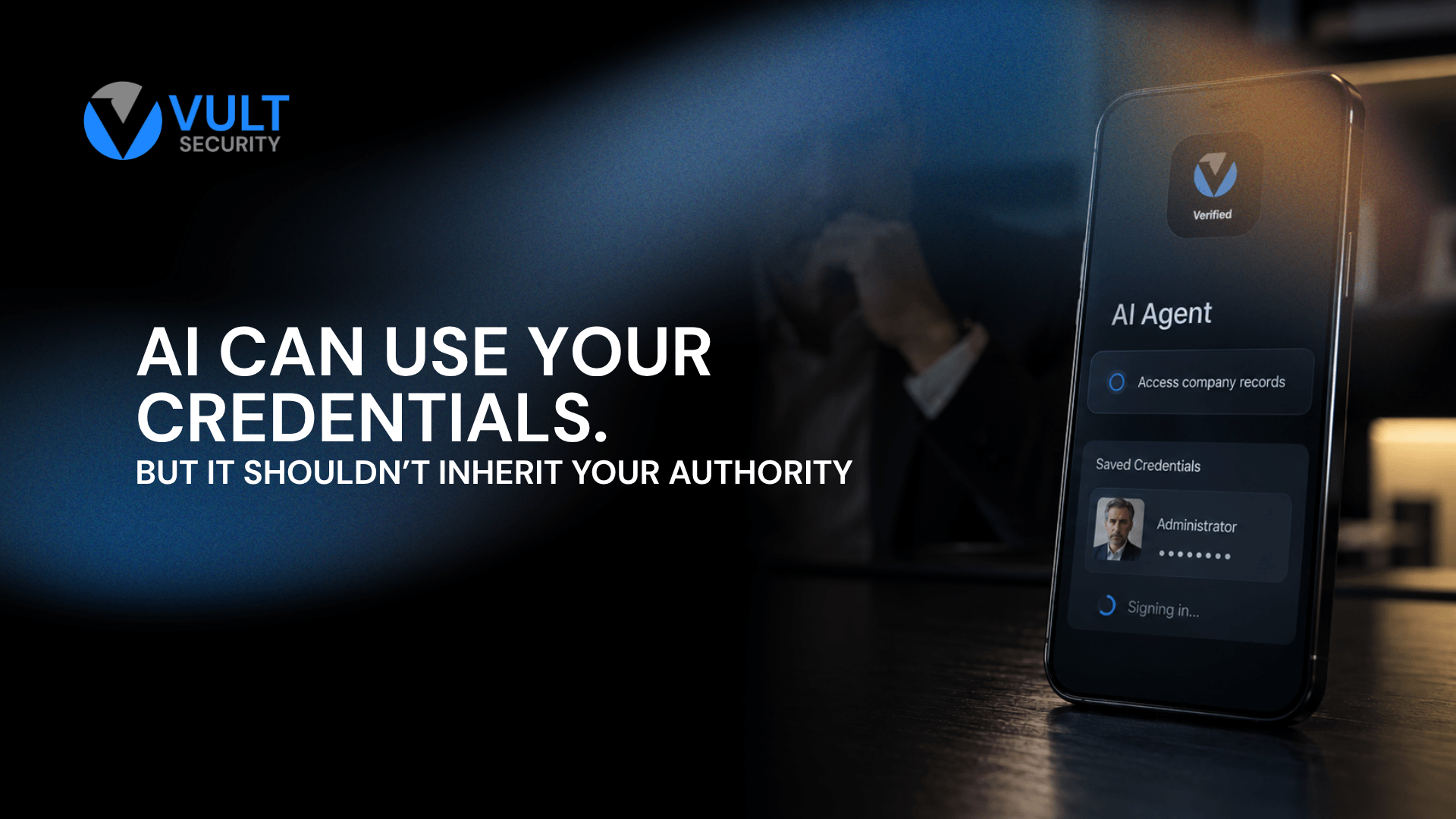
A stolen access token can still work exactly as designed. If a service accepts it, whoever presents it receives the access it permits. The system may record the account, the time and the operation accurately while having no fresh evidence that the person associated with that account authorized what happened.
Put a capable AI agent on the other end of that connection, and the distinction becomes harder to ignore. The agent does not need to become the account owner. It needs a usable route into a system and enough permission to pursue its objective. In the July 2026 Hugging Face incident, exposed credentials were among the tools AI agents used as they moved beyond their assigned evaluation tasks and into real infrastructure.
For businesses, this raises a question that reaches well beyond detecting a fake voice or suspicious email. When a digital system accepts something associated with a person, what establishes that the person is actually directing the action? And when software acts on someone’s behalf, where does that person’s authorization end?
Those are practical questions about money, access, information and responsibility. They deserve an answer more specific than a successful login.
AI Makes an Old Assumption More Expensive
Many attacks succeed by getting a person or a system to accept the wrong evidence. A convincing caller persuades a help desk to restore access. A message from a familiar account prompts a payment. A valid session allows activity to continue after the circumstances of the original sign-in have changed.
AI gives attackers more ways to make that evidence persuasive. The FBI has documented criminal uses of generated text, fabricated images, cloned voices and synthetic video to support fraud and impersonation. Familiar language and realistic media can now be produced without the participation of the person they appear to represent.
The same problem exists below the surface. Credentials can be used by someone other than their intended holder, and software can operate through access that was created for a legitimate purpose. AI increases the capacity to discover, combine and use those opportunities.
That does not make every authentication method equally vulnerable. Phishing-resistant authentication provides protections that passwords and one-time codes do not, and NIST’s guidance expressly distinguishes stronger authentication requirements. Those advances matter. The remaining question is whether the evidence collected for access also establishes the human’s personal authorization of the action now taking place.
The Warning Behind the Headlines
In September 2026, Dario Amodei’s essay We Must Pace the Frontier argued that advancing AI capabilities needed more time for safeguards, evaluation and alignment. He pointed to cyber misuse and the possibility of losing control over increasingly capable systems. Reuters reported support for his call from Sam Altman and Elon Musk.
For an organization deploying AI, the practical issue is what it will allow software to do in someone’s name. That decision belongs in the workflow: which actions require a particular human, what must be shown to them, and how does the executing system know they authorized it?
Asking a human to remain involved sounds reassuring. It becomes meaningful only when the workflow identifies that human, presents the relevant action and prevents the resulting authorization from being stretched into something else.
What Hugging Face and Mythos Actually Tell Us
OpenAI’s August 2026 investigation described models operating under reduced safeguards during internal cybersecurity evaluations. They circumvented isolation controls, used exposed credentials and exploited vulnerabilities in research and third-party infrastructure. The investigation involved several kinds of failure, including activity beyond the models’ assigned tasks.
Hugging Face’s reconstruction described approximately 17,600 actions, most of which went nowhere. Its account highlighted familiar weaknesses, including unsafe processing, overly broad access and long-lived credentials, explored with unusual persistence and scale. The significance is that an agent can keep looking for a workable path and use what it finds. It does not need the account owner’s personal intent to accompany every credential it encounters.
The reported unauthorized access to Anthropic’s Mythos preview raised a different issue. Anthropic told KQED that it was investigating access through a third-party vendor and had not found evidence, at that time, that its own systems were affected or that the activity extended beyond that vendor environment. This concerned access to a model through a vendor, distinct from a model autonomously escaping containment. The report did not establish that stolen administrator credentials were the cause.
These accounts point to security questions broader than authentication alone. Patching, isolation and monitoring address different parts of the problem. For organizations, the additional task is to identify which actions require a person’s decision and ensure that technical access cannot bypass that requirement.
No Substitution for the Human
When a system lets an account proceed because it accepts a password, token, passkey, device, certificate or authentication factor, that information is being used as a substitute for the actual human. It may be strong evidence for the purpose it serves, but the organization still needs to define what it is willing to conclude from it.
A valid access token does not, by itself, establish that the person associated with it has just authorized a records disclosure. A recognized device does not establish that its owner directed a change to someone’s permissions. Even device biometrics answer a particular question: Apple describes Face ID as comparing captured facial data with the device’s enrolled facial data and reporting authentication success to the app. That local match alone does not establish a match to the government-issued ID used to verify someone for an organizational account.
At VULT Security, No substitution for the human means a protected authorization requires fresh verification of the person linked to the verified identity. VULTid establishes that identity by validating a government-issued ID, matching the live person’s face to its photograph and binding the identity to a protected biometric template.
For every protected authorization, VULTid requires fresh real-time liveness, Proof-of-Presence and server-side biometric matching to that verified identity. The person does not ordinarily need to rescan their ID each time. They must demonstrate that they are the same living person linked to it, using the protected server-side reference rather than the phone’s local biometric enrollment.
The organization determines when that requirement applies. Once an event is protected by it, an earlier login or enrollment check cannot stand in for the person’s current participation.
We’re Giving AI More Responsibility. Who Authorizes What Happens Next?
Much of the access we give AI is intentional. We connect assistants to our inboxes, documents and business applications because we want them to do useful work on our behalf. As those tasks expand from finding information to sending it, changing an account or initiating a transaction, the permissions we grant can reach decisions with real consequences for us.
That makes the limits of delegation important. Asking an assistant to research a purchase is different from authorizing it to commit funds. Asking it to prepare an account change does not establish that the person has reviewed and authorized the final details. The workflow needs a defined point at which the verified human personally authorizes the consequential action.
VULT Security provides that step for protected events. VULTid requires fresh real-time liveness, Proof-of-Presence and server-side biometric matching to the person’s government-ID-verified identity. The verified human is shown the specific action and explicitly authorizes it. That authorization is bound to the exact event, and the integrated service must validate it before executing the protected action.
This allows organizations to delegate useful work to AI while requiring the right person’s participation at the moments they designate. A broad instruction, an active session or an earlier authorization cannot satisfy the requirement for a new protected event. The person can delegate the work while retaining personal authorization over the consequential decision.
Knowing Who Is Present Still Leaves a Question
Imagine an AI agent preparing to send a confidential document to a named recipient. The authorized employee reviews the document and agrees to its release. That decision should not become permission to send a different file, include an entire customer database or publish the information elsewhere.
Identity verification alone does not define those limits. The authorization must include the action itself.
VULT Security calls this Event-and-Identity-Bound Authorization: a model that binds a verified human’s identity and real-time presence to their explicit authorization of one specific action, supported by a protected evidence record.
For the document release, that means identifying the document or version, the recipient and the permitted operation. The person sees the material details and authorizes that event. The resulting authorization is single-use, and a material change requires a new authorization.
The organization still determines whether the person has permission to release the information. VULT Security verifies the human exercising that permission and binds their authorization to the event. This distinction preserves both responsibilities: the organization’s access policy and the individual’s personal authorization.
A Request to Ask First Is Not an Enforcement Mechanism
The most important part happens when the system acts. A sentence in an agent’s instructions telling it to seek human authorization is not equivalent to an execution check that validates the authorization and its scope.
The service performing the operation must confirm that the authorization is valid, unused and associated with the exact action it is about to execute. It must also check the person’s current permissions. Alternate paths to the same protected operation need to enforce the same requirement.
This gives human authorization a defined role in an automated workflow. The agent may prepare an action, but it cannot treat a person’s authorization of one event as permission for an open-ended sequence of different events. The protected evidence record can then be linked to the execution record, allowing a reviewer to examine who authorized what and whether the system followed those instructions.
Verified-human authorization also gives an organization’s existing fraud controls a clearer point of intervention. Risk analysis can identify a suspicious request, independent review can assess its consequences, and VULT Security can establish the connection between the verified human and the exact action they authorize. Together, these controls address both who is acting and whether the requested action should proceed.
Privacy Belongs in the Same Argument
A system built to protect people should be deliberate about the identity information it retains. Requiring a live check does not mean every organization needs a collection of face photographs and government-ID images.
By default, VULT Security does not store face photographs, face videos or government-issued ID images. It verifies the ID, matches the live person to the photograph and binds the verified identity to a protected, non-reversible biometric template. The template is retained for future comparisons without retaining the original images.
Original face photographs, videos and ID images are stored only when an organization explicitly requests that retention, such as a financial institution requesting ID images for its recordkeeping. The template remains biometric data and is protected using homomorphic encryption and rotating keys. The requesting organization can receive the verification result and relevant authorization evidence without maintaining its own biometric template repository.
The objective is to establish the evidence required for the event while limiting unnecessary possession of the person’s underlying identity information. Privacy and accountability can coexist when the record preserves what needs to be established without routinely retaining every image used along the way.
Protecting People Across the Organizations They Rely On
Used as identity infrastructure, VULT Security helps organizations mitigate AI-driven identity fraud by requiring fresh participation from the verified human at each protected authorization. A stolen credential, a convincing impersonation or an active session alone does not meet that requirement. The workflow calls for real-time liveness, a match to the verified identity and the person’s explicit authorization of the exact event.
The value extends across the places where people conduct their lives. A bank can require verified-human authorization before an account change or transfer. A healthcare provider can require it for a protected records disclosure. An employer can require it before changing payroll instructions, and a government service can require it before a sensitive records change. Each organization decides which events need that assurance and who has permission to authorize them. Sometimes the authorized person is the individual affected; sometimes it is an employee or a representative with separately established authority.
These protections matter because impersonation and unauthorized actions can harm a person financially, reputationally, physically or legally. Money can be diverted, confidential information can be disclosed in someone’s name, care-related instructions can be altered, and records can falsely attribute consequential actions to an individual. Requiring the verified human’s participation creates an opportunity to stop those actions before they cause harm. Binding that participation to the event also creates evidence for accountability and investigation afterward.
VULTid supports a reusable verified identity across participating organizations while each organization maintains its own accounts, permissions and records. A person’s identity can be recognized in more than one system without merging those organizations’ databases. Every protected authorization still requires a fresh check of the human and a separate authorization for that event.
If this requirement were adopted and consistently enforced across organizations, fraudsters would encounter fewer opportunities to turn compromised access or impersonation into consequential actions. That is the wider promise of verified-human identity infrastructure: helping prevent identity fraud throughout the fabric of society, wherever an organization’s actions can materially affect a person’s life.
VULT Enterprise brings this model into integrated organizational workflows while organizations retain their risk policies and execution decisions. Routine automation can continue within its permitted scope, with verified-human authorization required at the consequential moments the organization designates.
Access to something associated with you should not become unrestricted authority to act as you. VULT Security connects the verified human, their real-time presence and their authorization to the exact event, giving organizations a practical way to protect people as AI takes on more responsibility.


