
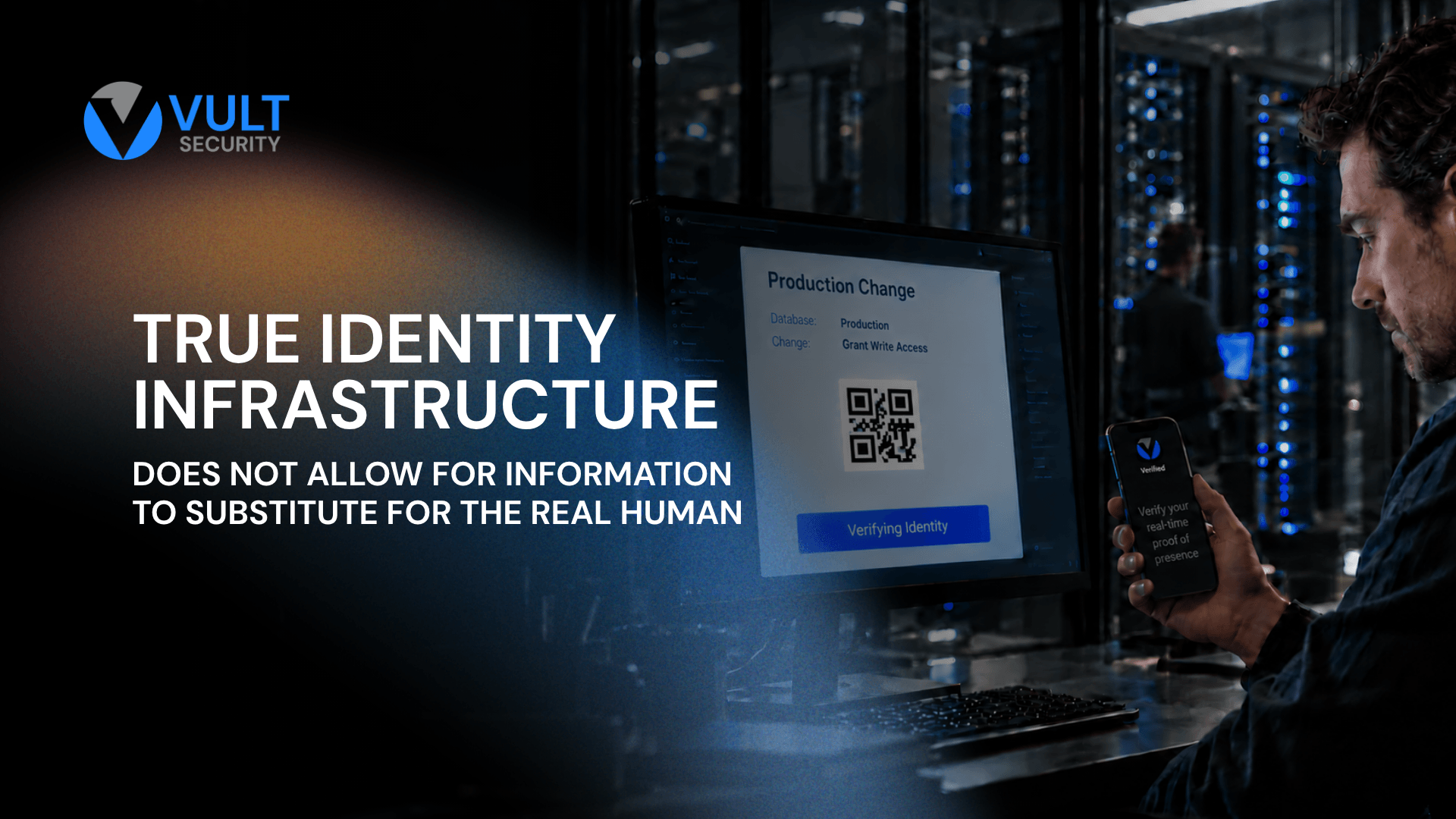
A valid login can still leave an organization unable to answer its most important question: which human actually authorized what happened next? An account may have passed every required check. The session may be active, the device recognized, and the permissions correct. Yet when a payment is disputed or a sensitive instruction is challenged, those records may establish account activity without establishing the person's participation in that particular event.
In many account-based systems, an accepted password, token, passkey, device, certificate, or authentication factor allows the account to proceed once the required checks pass. The system uses that evidence as a substitute for requiring the actual human to be verified at the moment of action. The strength of that evidence varies considerably, but the underlying question remains: what connects this activity to the specific person authorized to carry it out?
At VULT Security, we require the living, breathing, verified human to participate in the protected event. We connect identity verification against a government-issued ID with real-time biometric proof of presence and an explicit authorization tied to the exact action. A recognized device or valid session alone does not satisfy that requirement.
This is the purpose of verified-human infrastructure. It gives organizations a way to establish who authorized what while continuing to manage their own accounts, permissions, and policies. At VULT Security, we call this Event-and-Identity-Bound Authorization.
The Human Substitution Problem
Account security routinely depends on evidence that represents a person: a password, an authenticator, a certificate, or a session established earlier. NIST describes authentication in terms of establishing control over the secrets used to authenticate to a digital identity. NIST Digital Identity Guidelines
The human substitution problem arises when an organization treats that evidence as sufficient proof of the person's current participation. A system can accept a valid authentication result without separately establishing that the account's rightful owner is now authorizing a particular transfer, directive, disclosure, or change.
Consider an employee who signs in at the start of the day. That authentication can establish a session, but it does not establish the employee's personal authorization of every later action performed through it. If software operates within the session, the organization needs a way to distinguish the employee's authority from the software's activity.
For consequential events, the requirement should be explicit: the specific authorized human must participate, and the system must bind that participation to the defined action. Adding more information about the account does not automatically establish that connection.
Why “Something You Are” Can Be Misunderstood
Multi-factor authentication is commonly explained through three types of evidence:
Authentication factor | Familiar example |
Something you know | A password or PIN |
Something you have | A security key or device-held authenticator |
Something you are | A fingerprint or facial biometric |
The third phrase can sound like a promise that the system knows exactly which real-world person is present. The category describes a biometric factor; it does not, by itself, promise verification against a government-issued identity. NIST recognizes a biometric comparison as “something you are,” including when it activates a device authenticator. NIST guidance on biometric factors
In a typical passkey flow using local biometrics, the biometric comparison stays on the device. The service receives an authentication result rather than the person's biometric. That protects biometric privacy, but the result must be understood within its actual scope. FIDO Alliance explanation of passkeys
The WebAuthn standard makes the distinction clear: local user verification does not give the service a concrete identification of the user. It also recognizes that multiple people may share access to an authenticator through enrolled fingerprints or a shared PIN. W3C WebAuthn specification
An authenticator can therefore work as designed without establishing that the person using it is the bank's named customer or the enterprise's designated administrator. The organization is relying on the authenticator's result. Without an additional identity binding, that result should not be treated as proof of the specific ID-verified human.
Device enrollment and recovery protections also matter. It would be inaccurate to suggest that stealing any phone automatically lets someone add a biometric or bypass verification. Apple's Stolen Device Protection, for example, adds biometric requirements and security delays for sensitive changes. Apple's Stolen Device Protection
The stronger question is what a successful check actually establishes. If enrollment or verification controls are compromised, the organization needs more than confidence that an expected device returned a successful result. It needs a way to verify the authorized person independently of that device's locally enrolled biometrics.
Identity Verification Must Carry Forward to the Event
Identity verification establishes the connection between a person and their identity evidence. NIST distinguishes validating the evidence from verifying that the applicant is its rightful owner. Those are foundational steps in establishing whom an organization is dealing with. NIST identity proofing guidance
That connection should remain useful after enrollment. If a person verifies their identity when opening an account, the organization should be able to verify that same person when a consequential event requires their participation.
A bank may need to establish who is authorizing a wire months after account opening. An employer may need to establish who is exercising privileged access long after hiring. A healthcare provider may need to confirm who is authorizing a records release after the patient's original registration.
These situations require continuity between the identity established earlier and the human acting now. Requiring the person to submit an identity document for every interaction would be cumbersome. Accepting account access as the complete answer leaves the human substitution problem unresolved. A reusable verified-human identity makes another approach possible.
What Is Verified-Human Identity Infrastructure?
Verified-human identity infrastructure connects a person's identity, verified against a government-issued ID, with real-time biometric proof of presence and authorization of a specific event. It enables an organization to request that verification, enforce it within a workflow, and retrieve protected evidence of the authorization.
VULTid provides the verified-human identity used within VULT Security's infrastructure. During enrollment, VULT Security validates the identity document, uses a live facial capture to match the person to the document's portrait, and applies liveness detection. The resulting identity is bound to that person for future interactions.
When a protected event requires authorization, a fresh biometric capture is checked server-side for liveness and matched against the enrolled identity. The organization can then require the verified person's explicit authorization of the defined event. The device provides the capture interface; its local biometric enrollment does not determine which human VULT Security recognizes.
Moving a biometric check to a server is not, by itself, the defining advance. The value comes from connecting identity verification, current presence, the exact event, and the person's authorization within one enforceable process.
The Organization Grants Permission. The Human Exercises It.
A verified identity does not automatically confer access, ownership, or authority. Each organization decides which relationships exist, what an account may do, and whose authorization is required.
The organization uses its own identifier, such as a customer number, employee ID, or account reference, to locate the relevant relationship and permissions. VULT Security verifies the human associated with that relationship and their participation in the protected event. The organization applies its policy and determines whether the action proceeds.
This distinction keeps permission and personal authorization connected without confusing them. A person might have permission to transfer funds without having authorized the transfer currently being requested. An administrator might have permission to change a production system without having directed the command about to run.
VULT Security addresses the exercise of that authority: is the person who holds it actually present and authorizing this event? Permission remains the organization's decision. The human's participation becomes something the organization can verify.
Bind the Human to the Exact Event
Identity and presence are necessary, but they are incomplete without the action. A person can be present without having authorized a payment, disclosure, instruction, or change. A biometric match alone should not become unrestricted permission to act in that person's name.
VULT Security brings four elements together:
Verified identity + real-time human presence + a defined event + explicit authorization.
The event must contain the details that determine what the person is authorizing. For a wire transfer, that includes the relevant accounts, destination, and amount. For a records release, it includes the information and recipient. For an AI-directed action, it includes the specific instruction and its permitted scope.
Identity-bound means the workflow requires the verified person's current participation. A credential, recognized device, existing session, or previously captured biometric alone cannot satisfy that requirement.
Event-bound means the authorization is valid only for the action presented. It is not a reusable grant for a different action. If the recipient, amount, scope, or other material terms change, the changed event requires its own authorization.
The distinction matters just as much for instructions and access as it does for transactions. A human may authorize a command, initiate a request, delegate a defined task, or exercise an existing right. The infrastructure needs to capture the actual exercise of authority in each case.
The exact human and precise event, inseparably bound.
Authorization Needs Evidence That Can Be Examined
An access log can record which account signed in and what activity followed. When an event is disputed, an organization may need a more complete record: how the person was verified, whether they were present, what was presented to them, and what they explicitly authorized.
VULT Security's protected evidence record connects those elements. Its purpose is to preserve the relationship between the verified identity, current presence, defined event, and authorization so the organization can retrieve and examine the evidence.
That record supports fraud prevention and authorization accountability. It also creates a clearer basis for investigating a disputed event than an account identifier and timestamp alone. Evidence of authorization must still be assessed in context; it does not automatically establish that an instruction was lawful, free from coercion, or correctly executed.
The practical goal is straightforward: when an organization says a person authorized something, it should be able to show what supports that conclusion.
Where Verified-Human Authorization Applies
The same infrastructure can support different workflows because the organization defines the event and the authority required.
Use case | What the human authorizes | What the organization can verify |
Financial transfers | A defined transfer to a specific destination | The authorized person's presence and authorization of those transaction details |
Privileged access | Use of a specified resource or execution of a sensitive command | Which authorized administrator participated in that event |
Executive directives | A particular instruction or delegation | The verified executive's authorization of the recorded instruction |
Government services | A benefit request, records change, or service action | The verified person's participation in the defined request |
Healthcare | A records release or other protected decision | The relevant patient's, provider's, or representative's authorization |
AI agents | A specific action or bounded task | Which human authorized the agent's defined scope of activity |
For example, an AI assistant could prepare a payment instruction while the release of funds requires the authorized employee's real-time participation. The employee's authorization would apply to that payment. The agent would not gain unrestricted authority from an earlier login.
A directive delivered by phone, email, or chat can also trigger a separate authorization event. The verified person authorizes the recorded instruction through VULT Security. This establishes evidence for that instruction; it does not assume that the original communication channel proves the speaker or sender.
How Verified-Human Infrastructure Fits With IAM
Identity and access management remains responsible for accounts, directories, access policies, roles, permissions, and the lifecycle of those relationships. Organizations can introduce verified-human authorization at the points where their existing workflows require the person's current participation.
Authentication methods also differ substantially in strength. Passkeys provide phishing-resistant authentication and are a meaningful advance over passwords. Their value should be assessed alongside the separate requirement to establish a particular person's authorization of a particular event. FIDO Alliance on passkey security
Existing capability | Question it addresses | What VULT Security adds to the workflow |
Identity proofing | Does this identity evidence belong to the applicant? | A reusable connection to the same verified person |
Account authentication | Does the requester satisfy the authentication requirements? | Fresh biometric verification of the ID-verified human |
Access management | Is this account permitted to access the resource? | Verification of the human exercising that access |
Authorization policy | Is the requested action permitted under policy? | The verified person's explicit authorization of the exact event |
Audit logging | What activity did the system record? | Protected evidence connecting the person to the authorization |
Integration places that requirement where it matters: before the sensitive action proceeds. The organization requests verification and authorization, evaluates the result under its policy, and enforces the decision. This approach lets existing IAM and transaction systems continue doing their jobs while adding evidence of the human exercising authority.
A Category Built Around Human Authorization
At VULT Security, we call this category Event-and-Identity-Bound Authorization. The name describes the requirement: bind the authorization to both the verified human and the exact event.
Our positioning within cybersecurity is:
Classification | VULT Security positioning |
Industry | Cybersecurity |
Market | Identity Security |
Domain | Human Digital Identity |
Category | Event-and-Identity-Bound Authorization |
Technology | Verified-human infrastructure |
Primary outcome | Fraud Prevention and Authorization Accountability |
This category brings together capabilities that are often discussed separately: identity verification, biometric presence, authorization, and evidence. Its purpose is to make the human's exercise of authority verifiable within the systems organizations already operate.
VULT Security binds verified identity, human presence, the authorization event, and explicit human authorization into one private interaction, backed by a protected evidence record built to establish accountability and withstand scrutiny.
Stronger Identity Assurance Must Protect Privacy
Verifying the human should minimize the identity information distributed across organizations. A business requesting authorization of a transaction needs the relevant result and evidence, with disclosure limited to what the workflow requires.
VULT Security's design uses the government-issued ID and live facial capture during verification without retaining the ID image or raw face photographs afterward. It retains a protected facial template for subsequent comparisons. That template is biometric data, even though it is not a photograph, and it requires protection accordingly.
The requesting organization receives the relevant verification and authorization result rather than the underlying ID image, face photograph, or facial template. Depending on the interaction, the result might establish a required identity attribute, confirm the verified person's presence, or confirm their authorization of the event.
Reducing unnecessary retention and disclosure limits exposure. It also keeps the purpose of verification clear: establish the facts needed for an interaction while protecting the person behind them.
The AI Era Requires a Clear Boundary for Human Authority
Organizations increasingly need to distinguish a person acting directly from software acting under delegated authority. They also need to distinguish both from an unauthorized actor operating through compromised access. The existence of a valid account or session does not resolve every one of those questions.
This changes what organizations should demand at the point of consequence. An automated process can prepare an instruction, assemble a request, or recommend a decision. Where policy requires a specific human's authorization, the system must establish that person's participation and constrain execution to the event they authorized.
That requirement should be enforceable before the action proceeds and examinable afterward. It should survive changes in devices, interfaces, and the amount of automation surrounding the person.
True identity infrastructure makes the human's role explicit. The organization defines the authority. The verified person exercises it. The system binds that authorization to the event and preserves the evidence.
For VULT Security, that is the standard: know which human authorized what.


