
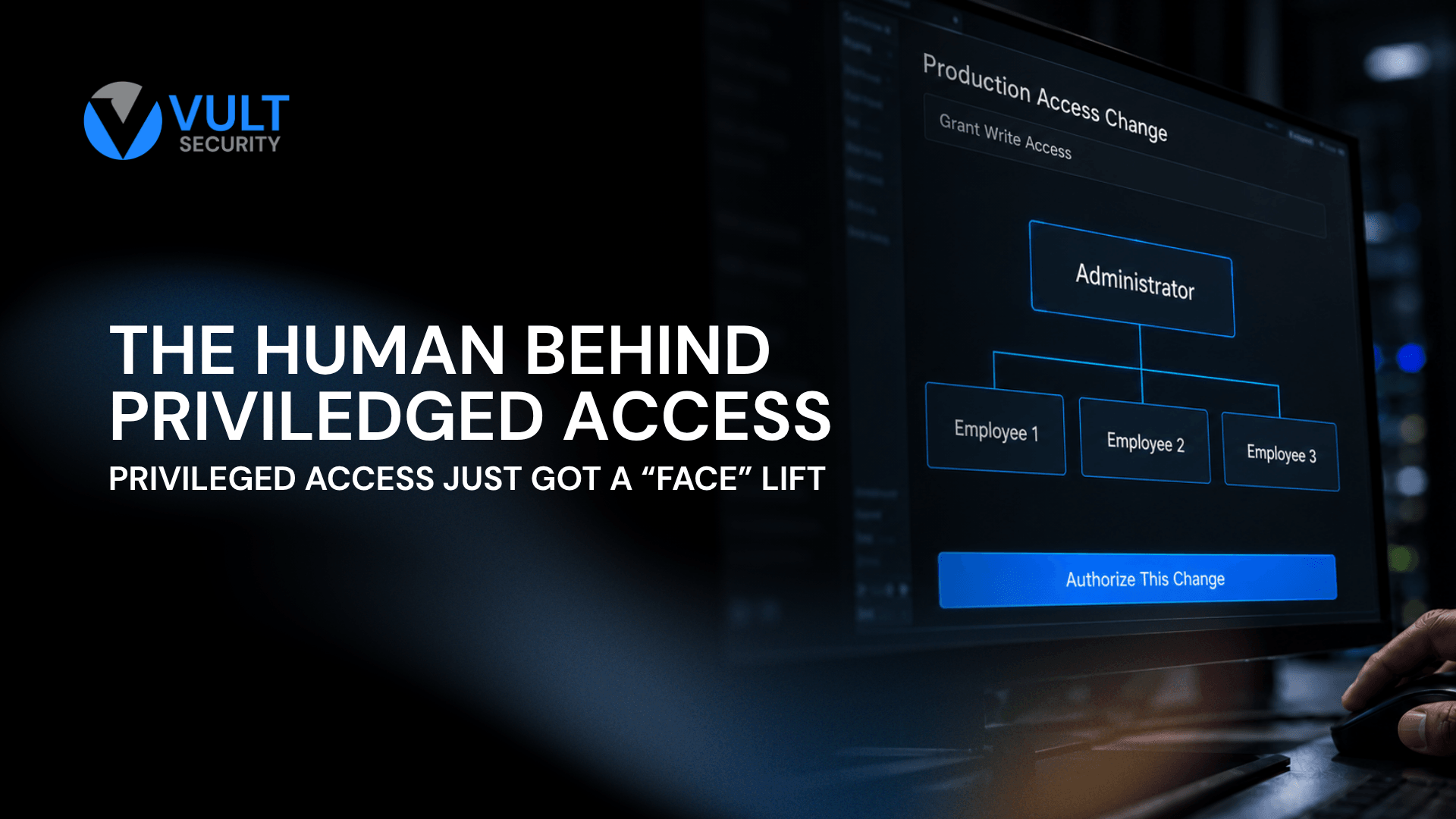
An administrator can change the rules everyone else must follow. They can create another administrator, alter production access or disable a security control. A single privileged action can affect an entire organization.
Enterprises put substantial controls around that power. They restrict roles, limit access windows, secure credentials and monitor privileged sessions. Yet before a consequential change takes effect, the organization still needs to establish something specific:
Is the verified person entrusted with this privilege present and personally authorizing this exact action?
Verified-human authorization connects an individual’s verified identity and real-time presence to a specific action. VULT Security brings that model into protected enterprise workflows, using a government-ID-verified identity, fresh server-side liveness and biometric matching, and an authorization bound to the event.
The enterprise continues to determine who receives permission. VULT Security verifies the human exercising it.
What PAM and PIM Already Do
Privileged Access Management (PAM) protects and governs elevated access to systems, accounts and resources. Depending on the platform, it can include credential vaulting and rotation, session isolation and recording, and restrictions on privileged activity.
Privileged Identity Management (PIM) governs privileged identities and role assignments, including eligibility, activation and duration. Microsoft Entra PIM, for example, supports just-in-time access, time-limited roles, MFA requirements, access reviews and audit history. These capabilities overlap with the broader PAM market; the exact boundaries vary by product.
Modern platforms also go beyond checking access at sign-in. Microsoft Entra protected actions can apply additional Conditional Access requirements when someone attempts specific privileged operations.
VULT Security builds on that existing discipline with a particular requirement: verify the government-ID-linked human through fresh liveness and biometric matching, and bind their authorization to the exact protected event.
The enterprise governs the privilege. VULT Security verifies the human and binds their authorization to its specific use.
No Substitution for the Human
When a system lets an account proceed because it accepts a password, token, passkey, device, certificate or authentication factor, that information is being used as a substitute for the actual human.
The strength of these methods differs. Phishing-resistant authentication offers protections that passwords and one-time codes do not. NIST’s digital authentication guidance describes verification of control over authenticators associated with an account and sets stronger requirements at higher assurance levels.
For a sensitive administrative action, the organization can require more specific evidence of the person and their intent: a fresh match to the verified identity and an explicit authorization of the event presented.
At VULT Security, the principle is No substitution for the human. A valid credential, active session or previous identity check does not satisfy the fresh human verification required for a protected event.
Security responsibility | Enterprise PAM, PIM and related controls | What VULT Security adds |
Granting privilege | Determine role eligibility, permissions and access scope. | Verify the human linked to the organizational account; the enterprise retains the permission decision. |
Limiting access | Govern activation, duration, revocation and permitted resources. | Require fresh human verification at the protected events selected by the enterprise. |
Confirming the user | Apply configured authentication and access policies. | Match the live person to an identity established using a verified government-issued ID. |
Protecting sensitive actions | Apply workflow, resource and command restrictions where supported. | Bind the verified person’s explicit authorization to the exact event presented. |
Establishing accountability | Record role changes, sessions, commands and other activity. | Add protected evidence connecting verified identity, real-time presence and the specific authorization. |
Verify the Person Every Time a Protected Event Requires Them
VULTid establishes a reusable verified identity by validating a government-issued ID, matching the live person’s face to the ID photograph and binding that identity to a protected biometric template.
For every protected authorization, VULTid requires fresh real-time liveness, Proof-of-Presence and server-side biometric matching to that verified identity. Enrollment provides the identity reference. The live check establishes the person’s presence at the event.
The administrator does not ordinarily need to rescan their ID each time. They must demonstrate that they are the same living person linked to it.
This differs from relying on a device’s local biometric enrollment. Apple explains that Face ID compares captured facial data with the device’s enrolled facial data and reports authentication success to an app. That local check has value, but its result alone does not establish a match to the government-issued ID used in the enterprise’s identity verification.
VULTid uses the protected server-side identity reference for that comparison. The device provides a way to interact with the system; its locally enrolled biometric does not determine the verified identity.
The enterprise chooses which events require VULTid. Every event protected by that requirement receives a fresh human check.
Role Elevation and a Production Change Are Separate Events
This distinction is central to privileged security.
An engineer may be authorized to activate an administrative role for 30 minutes. During that window, the role may permit many actions. Confirming the engineer at activation does not establish that they personally authorized every command that follows.
An enterprise can protect the elevation event and separately protect selected actions within the resulting session.
VULT Security calls this model Event-and-Identity-Bound Authorization: binding a verified human’s identity and real-time presence to their authorization of one specific action, supported by a protected evidence record.
For role elevation, the event can specify the account, requested role, resource scope and duration. For a production change, it must identify the actual operation, affected environment and material parameters.
The person must be shown meaningful details of what they are authorizing. A general prompt to confirm their identity is insufficient to establish authorization of an undisclosed change.
Authorizing access to a role is not a blanket authorization for everything that role can do.
The authorization is single-use and bound to the defined event and verified human. Changing the target system, scope, requested privilege or other material event details requires a new authorization.
A Practical Example: Changing Production Access
Suppose a cloud engineer needs to change access to a production database. The enterprise has made the engineer eligible for a temporary administrative role, and its policy requires verified-human authorization for this type of change.
- The enterprise evaluates the request. Its PAM, PIM and policy systems determine whether the engineer is eligible and whether the requested access falls within permitted scope and duration.
- The workflow defines the protected event. The engineer sees the database, account or group affected, the proposed permission change and any other material instructions.
- VULT Security verifies the human. Fresh liveness and server-side biometric matching confirm the engineer against their government-ID-linked identity. Their explicit authorization is bound to the presented change.
- The enterprise validates and executes. The executing system checks the person’s current permissions, confirms that the authorization is valid and unused, and verifies that its scope matches the operation before applying the change.
- The records are connected. The protected authorization record is linked to the enterprise’s execution and audit records.
A request to modify a different database cannot reuse the first authorization. If fresh verification is required but cannot be completed, the ordinary protected workflow cannot proceed as though the person had been verified.
The enforcement point matters. The system applying the change must validate the authorization. Adding verification only at session entry does not provide event binding for later commands, and alternate execution paths need to follow the same policy.
Choose the Events Where Human Authorization Matters Most
Privileged security does not require treating every administrative interaction identically. The enterprise decides where the potential consequence justifies a fresh human check.
Useful starting points include:
- Activating a powerful role or extending its duration.
- Creating an administrator or changing privileged permissions.
- Modifying identity, authentication or account-recovery policies.
- Disabling logging or other security controls.
- Changing production infrastructure or sensitive database access.
- Retrieving critical secrets or authorizing a protected data export.
- Granting sensitive access to a contractor or third party.
Each event needs a clear scope and an integration point that can enforce the result. The enterprise can begin with a small number of consequential workflows and expand coverage as those integrations are established.
Third-Party Access Should Still Resolve to a Specific Person
Vendors, contractors and managed service providers may need substantial access without being permanent members of the enterprise. The organization still needs to know which individual is exercising that access.
VULTid can verify the named contractor during a protected event, while the enterprise’s PAM or PIM controls determine what that contractor may do and for how long.
The verified identity and the organization’s permissions remain separate. A person may use VULTid with multiple participating organizations, but each organization maintains its own account relationship and access decisions. Recognition of the same person does not transfer privileges from one enterprise to another.
This provides continuity of human verification while preserving local control over enterprise access.
AI Makes Convincing Requests Easier to Manufacture
The FBI has warned that criminals use generated text, cloned voices and synthetic video to make fraud more convincing. These techniques can make a request appear to come from someone trusted.
For privileged workflows, the practical concern is a persuasive request to reset access, extend a contractor’s permissions or make an urgent production change. The organization should require the designated human to authorize the defined event through its protected workflow.
When automation executes a sensitive action on a person’s behalf, the same principle can apply: the human authorizes the specific event, and the executing workflow enforces its scope. One human check should not become unrestricted permission for an automated process or AI agent.
Protect the Administrator’s Privacy
Employees and contractors should not have to surrender an unnecessary collection of identity images to every system they administer.
By default, VULT Security does not store face photographs, face videos or government-issued ID images.
The platform verifies the government-issued ID, matches the live person’s face to the ID photograph and binds the verified identity to a protected, non-reversible biometric template. It retains that template for future comparisons without retaining the original face or ID images.
Face photographs, videos and ID images are retained only when an organization explicitly requests that storage. Image retention is a requested arrangement, not the default.
The retained template remains biometric data. VULT Security protects it using homomorphic encryption and rotating keys. The enterprise can receive the required verification result and authorization evidence without operating its own biometric template repository.
Accountability That Goes Beyond the Account Name
An administrative log may show that an account changed a security policy. A session recording may show how the change occurred. A protected authorization record adds evidence connecting the verified human, their real-time presence and the particular change they authorized.
Together, those records help investigators examine who authorized what, when the authorization occurred and whether the executed operation matched it. They can support incident response, access reviews, disputes, audits and legal review.
Authorization evidence and execution evidence should be traceable to one another. Verifying an event does not, by itself, establish that the system later executed it exactly as intended.
A verified employee can still make a mistake or deliberately misuse legitimate access. Least privilege, separation of duties, monitoring and other enterprise controls remain necessary. Human verification strengthens identity assurance and accountability within that broader defense.
Bring Verified-Human Authorization Into the Existing Security Stack
VULT Enterprise adds this capability within integrated enterprise workflows. The organization retains control of entitlements, credential management, session controls, revocation, risk policy and execution decisions.
Implementation should identify the protected events, map verified identities to organizational accounts and enforce the authorization at the point where the action occurs. Coverage depends on the workflows and enforcement points that are integrated.
For institutional due diligence, VULT Security’s assurance materials include its completed 2026 SOC 2 Type II attestation and ISO/IEC 27001:2022 certification. Those materials support review of the covered controls alongside the proposed deployment.
Explore VULT Security’s capabilities for the broader identity, privacy and authorization model. View the full capability and competitor comparison for the detailed feature and assurance assessment.
Privileged access entrusts people with the power to affect everyone else. A complete authorization record should connect that responsibility to the verified person and the action they personally authorized.
Protect the privilege. Verify the human. Bind the authorization to the action.


