
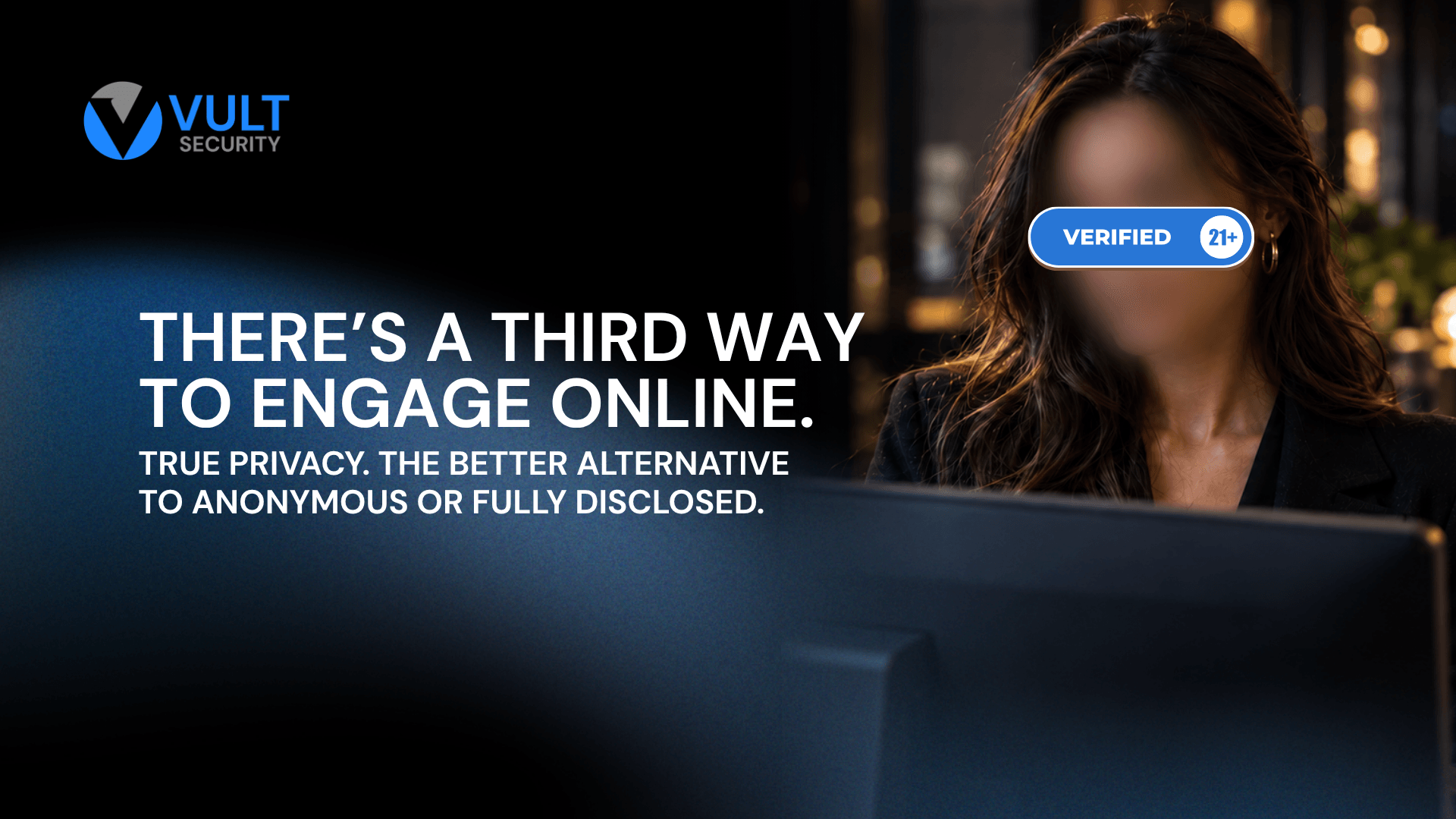
An age check should be a small exchange. A website needs to know whether someone is old enough to use its service, yet the process may begin with a request for a driver’s license. Along with evidence of age comes a photograph, an address, an exact birth date, and an identification number. Depending on how verification is handled, information needed briefly to establish a fact can become information retained long after the interaction ends.
People have good reason to question that exchange. They want access to a service, not a lasting relationship with every database involved in verifying them. Businesses have reasons to reconsider it, too: collecting more personal information creates more information to protect and more consequences if that protection fails.
At VULT Security, we believe a person should be able to establish a verified identity and use it without repeatedly distributing the documents and images behind it. The organization should receive the information its purpose requires, while the person remains an active participant in how their identity is used. That is the third model for trust online: strong verification, limited disclosure, and a continuing connection to the actual human.
How Verification Becomes an Identity Honey Pot
Identity verification serves a legitimate purpose. Organizations need to distinguish real people from impersonators, establish who owns an account, and protect services that depend on accurate identity. The security question extends beyond how well a verification check works to what happens to the information afterward.
When government ID images, face photographs, addresses, and identification numbers accumulate across organizations and service providers, they create concentrated stores of sensitive information. An attacker who compromises one of those stores may gain material that can be used against many people. The organization faces the immediate breach; the people whose information was exposed may spend years dealing with the consequences.
Calling this an identity honey pot captures the attraction of that concentration. It also points to a practical security decision: reduce unnecessary collection and retention before adding another repository to defend. NIST’s identity guidelines identify data minimization as a way to reduce information vulnerable to unauthorized access or use. The FTC similarly advises businesses to collect and retain sensitive information only when there is a legitimate need, and only for as long as necessary. [1][2]
For an identity system, this means examining three separate questions: what must be processed to verify the person, what must be retained afterward, and what the requesting organization actually needs to receive. Those answers do not have to be identical.
Being Verified Should Not Require Being Fully Exposed
The privacy debate often gets reduced to a choice between identifying yourself and remaining anonymous. That framing overlooks the many interactions in which an organization needs a verified fact without needing a complete identity record.
An age-restricted service may need confirmation that someone is over 21. A social platform may need to establish that an account is controlled by a verified person while allowing that person to use a public pseudonym. A bank needs more identifying information because its relationship with the customer carries different responsibilities. Treating these situations alike produces either unnecessary disclosure or insufficient assurance.
Selective disclosure provides a more useful approach: share the verified attributes required for the interaction. NIST describes this directly in its federation guidance, including the use of a derived attribute that answers an age-threshold question without revealing the person’s full birth date. [3]
The opportunity is to make that principle part of the experience people actually use. Someone should be able to demonstrate a relevant fact without surrendering unrelated information simply because it appears on the same document.
How VULTid Connects a Verified Identity to Its Human Owner
VULTid is a reusable digital identity established by validating a government-issued identity document, matching the person’s face to the document, and performing real-time liveness detection. These checks connect the claimed identity to the person presenting it. Identity proofing standards distinguish evidence validation from verification of its connection to the applicant, an important distinction when a legitimate document could be presented by someone else. [4]
Once that relationship is established, VULTid allows the person to use their verified identity across participating organizations. An age check can request an age result; another interaction can request a verified name. Reusing VULTid does not require every organization to receive the same information or gain access to another organization’s accounts and records.
The connection to the person also continues beyond enrollment. Every protected event routed through VULTid requires fresh, real-time liveness and server-side biometric comparison against the protected reference bound to that verified identity. The person does not routinely need to resubmit their government ID for each event, but an earlier successful enrollment is not accepted as evidence that they are present now.
What VULT Security Retains, and What It Does Not
By default, VULT Security does not retain original face photographs, face videos, or government ID images. The platform validates the ID, matches the live person to it, and binds the two through a protected biometric template. That retained template supports later comparison without keeping the original face or ID images.
The template is a non-reversible mathematical representation designed for biometric comparison. It is protected with homomorphic encryption and rotating keys. It remains sensitive biometric data, and VULT Security treats it accordingly; the privacy benefit comes from protecting that reference while avoiding unnecessary retention and distribution of the original media.
Original face photographs, videos, or ID images can be retained when an organization explicitly requests that configuration. A financial institution, for example, may have a documented need to retain particular evidence. That is a deliberate retention choice rather than the platform’s default.
In the standard workflow, the requesting organization receives the verification or authorization result and the identity attributes required for its purpose. It does not need possession of the biometric template or its own biometric database to establish that the verified person is present.
The Information Shared Should Fit the Interaction
Consider the age check again. With VULTid, a participating website can receive confirmation that a verified person meets its age requirement. The website does not need the person’s exact birth date, home address, license number, face photograph, or biometric template merely to answer that question.
A social platform has a different need. It may want confidence that an account is connected to a verified human without requiring the person’s legal name to appear publicly. That allows private identity verification and public identity presentation to serve different purposes. A person can participate under a chosen name while the platform applies its rules for verified accounts.
Banking requires a broader disclosure. U.S. customer identification rules require banks to obtain identifying information, verify identity, and maintain specified records. A simple age result cannot replace those obligations. VULTid can support the disclosure of the required verified information while limiting unnecessary exposure of the underlying documents and biometric data. [5]
These examples make the principle concrete: an organization’s information needs should follow the purpose of the relationship. The fact that a person has established a verified identity does not make every detail of that identity relevant to every organization they encounter.
Privacy Must Continue When the Person Takes Action
Knowing who opened an account does not, by itself, establish who is directing a later transfer, changing account settings, or requesting access to sensitive records. Many workflows rely on passwords, tokens, one-time codes, recognized devices, authenticator applications, or an active session to make that connection.
These controls have value, and stronger authentication can substantially improve security. But they establish assurance through accepted authentication factors. A successful authentication does not automatically establish that the government-ID-verified person is currently present and knowingly authorizing the exact action being executed. NIST treats identity proofing and authentication as distinct parts of digital identity, with different requirements and purposes. [4][6]
VULT Security requires the actual verified person to participate when a protected event calls for human authorization. Fresh liveness establishes presence, biometric comparison connects that presence to the verified identity, and the person explicitly authorizes the action presented. There is no substitution for the human in that protected authorization.
At VULT Security, we call this Event-and-Identity-Bound Authorization: binding the verified person’s identity and real-time presence to their authorization of one specific action. The authorization applies to that event and is single-use. If material details change, the changed event requires a new authorization.
The organization still determines permissions and enforces whether the action may proceed. VULT Security confirms the human exercising those permissions and creates a protected evidence record connecting the person, presence, event, and authorization. This supports accountability and traceability without requiring the organization to retain the person’s original biometric images. OWASP’s transaction authorization guidance reinforces the importance of presenting meaningful action details and enforcing authorization for the operation actually executed. [7]
Why Device Biometrics Answer a Different Question
A phone’s face or fingerprint recognition can provide strong local protection. Apple explains that Face ID compares captured facial information with the reference enrolled on the device, while applications receive an authentication result rather than access to the face data. That is a useful privacy and security design. [8]
The distinction is what the external organization learns from that result. A successful local biometric check does not, by itself, establish that the enrolled biometric belongs to the person identified by a validated government document. W3C’s WebAuthn specification also explains that authenticator user verification does not provide a concrete identification of the user to the relying service, and that multiple people may have access to the same authenticator. [9]
VULT Security connects the live biometric comparison to the previously verified identity and, when authorization is required, to the defined event. The device captures the interaction; the device’s local recognition result does not replace verification of the human.
How the VULT Security Products Work Together
VULT Security provides the verified-human infrastructure, while VULTid is the person’s reusable verified digital identity. Together, they support selective disclosure and real-time participation in protected interactions.
VULT Enterprise brings these capabilities to businesses, financial institutions, healthcare organizations, and other commercial environments. Organizations can request verified attributes, proof of presence, and Event-and-Identity-Bound Authorization while retaining control over their own accounts, permissions, and workflows.
VULT Sovereign provides available specialty capabilities for selected governments and defense environments, offered on an a la carte basis according to the deployment’s requirements. These government services are distinct from the standard enterprise offering. Across the products, the purpose remains consistent: connect the organization’s request to the verified person while limiting unnecessary exposure. [10]
Trust Should Not Require a Growing Collection of Identity Copies
The pressure to establish who is real is increasing. The FBI has documented criminals using AI-generated images, fraudulent identity documents, cloned voices, and video impersonation to support financial fraud. Responding to that pressure by accumulating more copies of personal information can leave organizations with a larger collection to protect without resolving who is present at the moment of action. [11]
A better approach carries verification forward. The person establishes a verified identity, shares the attributes an interaction requires, and participates through fresh verification when an event needs their authorization. Organizations gain evidence relevant to the decision they are making, while people avoid repeatedly distributing the underlying documents and images.
For an age check, that may mean sharing only whether a threshold is met. For a bank, it may mean providing the required identity information and later authorizing a specific transfer. The amount disclosed changes with the purpose; the connection to the verified human remains.
With VULTid, the individual directs how their verified identity is used, while organizations receive the information and evidence needed for the specific interaction. That is a practical foundation for trust: people can establish who they are without making unnecessary exposure the price of being believed.


